Inspired by Verity Elston who first initiated such a resource on her former website (portfolio-formation.ch).
Last year I was looking for jobs and had built my own list of favorite websites. Now I thought it could be nice to combine it with Verity’s resource to make a new one! 🙂
Mixing websites for non-academic and academic jobs, specific and less-specific to Switzerland too.
This resource does not pretend to be exhaustive; also it’s a bit biased towards STEM, after all, I’m a biologist 😉 🧬 Some, like the confederation websites, does not come in ENglish.
1. Websites specific for Switzerland and adapted to PhD level
myscience.ch/jobs Select for Swiss regions and filters for categories or types of jobs.
kellyservices.chNot specific for PhD holders but many high-level jobs, you can also upload a CV to be visible to employers, and can get counseling support.
ctcresourcing.comPharma / Biotech / / MedTech jobs in Switzerland and Germany.
jobvector.ch “The career portal for Engineers, IT, Physicians & Scientists.”
The Swiss Federal Administration: Professor, postdoc, technician, manager and other scientists positions are usually advertised here on top of the university or company website. Browsing through this website is also a nice way to learn about the many job types within the Swiss Confederation.
Swissuniversities“The umbrella organisation of the Swiss universities”
Innosuissethe Swiss Innovation Agency from the Confederation.
Hoping this resource can help finishing-PhD candidates and other Early Career Researchers in Switzerland to find suitable jobs, thanks for reading this post today! 🙂 My pro tip: make your own list for easy clicking-and-browsing websites every week; job hunting is a pain, making it easier for yourself! Also, well… you know, networking does help a lot in finding good opportunities, but that would be the subject of another full blog post!
A final word:
If you are unemployed in Switzerland, you may want to have a look at the BNF program which can help to find “internships” covered by the unemployment insurance (chômage)
“BNF is active throughout Switzerland and has 20 years of experience in supporting academics. We assist highly qualified specialists at career crossroads through personal counseling, fostering professional networks and focussed training so that they can successfully place their professional know-how and skills in the job market.”
To receive my articles directly in your emails, just sign up below!
Hello dear reader, I know I haven’t been posting for a while… I got busy starting a new job, settling in a new city, dealing with personal projects… Now the covid-19 is clearing up my personal agenda with an impressive efficiency: workshop postponed, career talk postponed, my wedding postponed… well, no more excuses for procrastination and let’s get back to blogging! 🙂 Always trying to see the bright side of things even though this situation is not fun, to say the least!
For today’s post, I told myself: so many soft skills workshops are being canceled or postponed, leaving locked-down PhD students even more alone with their career questions… but actually there are many tools available online!
⚠️ Warning: actually I’m reusing a lot the contents from my previous blog posts! Just putting everything in one place 🙂
Keeping my dear Switzerland in mind, let’s start with what is still available in Swiss universities 🇨🇭
Swiss Career Development Programs for PhD students, during lockdown
Online tools for Self-Assessing your Skills, Interests & Values
More Online Career Resources
1. Swiss Career Development Programs for PhD students, during lockdown
Coordinators of career development programs for PhDs in Switzerland are currently doing an amazing job to maintain many workshops online, applause to all!! 👏👏
CUSO
For Western Switzerland, the CUSO transferable skills program has been transforming some workshops into online ones and they are even offering new ones, make sure to keep an eye on their program here!
They are also regularly posting on their blog, sharing tips and other relevant information for PhD students during this challenging time, posting both in French and English 🙂
Disclaimer: I worked for CUSO in November and December last year (2019), plus I have been a big fan of their work since many many years given how much this program helped me during my PhD (as you can read here). So let’s be honest saying I’m a bit biased when recommending this amazing program! 😀 Don’t just take my words, have a look yourself!
Today I only checked out the Graduate Campuses in Lausanne, Zurich and Basel, and I can tell you that they are having many workshops online, impressive!
2. Online tools for Self-Assessing your Skills, Interests & Values
This has been developed by the journal Science and their Science Career team since 2003 (yes, 2003!!).
“You have put a lot of time and effort into pursuing your PhD degree. Now it’s time to focus on how to leverage your expertise into a satisfying and productive career. The Individual Development Plan (IDP) concept is commonly used in industry to help employees define and pursue their career goals. In 2003, the Federation of American Societies for Experimental Biology (FASEB) proposed an IDP framework for postdoctoral fellows in the sciences. AAAS/Science joined forces with FASEB and experts from several universities (see authors below) to expand on that framework. The result is myIDP—a unique, web-based career-planning tool tailored to meet the needs of PhD students and postdocs in the sciences.”
Here you will be asked to fill up 3 questionnaires for self-assessing:
your skills (exampe: How is your level for writing scientific publications on a scale of 1 to 5?)
your interets = the things you like to do (example: do you like writing scientific publications?)
your values (example: how important is it for you to “have some choice over the hours or days that [you] work”?)
Then based on your answers, this IDP tool will match a list of career paths (academic and non-academic) and for each they have resources with blog posts, articles, books, etc. for you to explore further.
I’ve done it a couple of times for myself, I highly recommend it! 🙂
SSH = Social Sciences and Humanities. However, I also recommend it for STEM in addition to the myIDP, because I find the values assessment questionnaire and results more complete (plus the website is all new and beautiful).
“Following a similar process that resulted in the creation of the myIDP online career tool for STEM fields, the ImaginePhD team engaged ‘experts’ to complete surveys to gather data to match skills and interests to sixteen job families.”
“ImaginePhD is a free online career exploration and planning tool for PhD students and postdoctoral scholars in the humanities and social sciences.
Humanities and social sciences PhD students and their mentors have long recognized the need for more resources to help bridge the knowledge gap between doctoral education and the realm of career possibilities. ImaginePhD is designed to meet this need by allowing users to:
assess their career-related skills, interests, and values
explore careers paths appropriate to their disciplines
create self-defined goals
map out next steps for career and professional development success”
Quickly first about Vitae: “We are a non-profit programme, part of The Careers Research and Advisory Centre (CRAC) Ltd with nearly 50 years’ experience in enhancing the skills and careers of researchers”
I have been recommended Vitae and the work they do quite many times, specifically their Research Development Framework to help us reflect on our own skills.
However, given that their online planner is not free, I haven’t tried it myself yet…
Now about the RDF Planner: have a look at their nice presentation video.
“Take control of your professional and career development with the Vitae RDF Planner
Identify your expertise and capabilities
Plan your career
Focus your training effort where it is needed most
Record and showcase your achievements
Monitor your progress
Use in professional development review meetings with your supervisor or PI”
This online tool guides you step by step to reflect on your skills and to build your portfolio. It offers to create an online profile by adding the skills which you think you have. However, compared to myIDP or ImaginePhD for example, here there are no questionnaires. You will have to judge your own level for each skill. Thus, it’s likely to be subjective, but it’s still a good tool to use.
In particular, what I like on this website is that for each skill it encourages to write a short paragraph to describe how you acquired this skill. Taking the time to write this down will be a great advantage for when you are in a job interview and someone ask, for example, “how do you manage conflict?” Read more about this idea of portfolio here and here.
At the same time, you are creating an online profile meaning you are visible to potential employers and you can look for jobs on their platform (for industry).
“DocPro provides you with a clear and well-structured vision of the skills you have to offer an employer. It is a tool for analysis, self-assessment and communication that will help you prepare for a career move and capitalize on your skills.”
“The application guides you step by step to:
identify the competencies you wish to highlight;
determine your progress with respect to the three phases of maturity defined by the tool;
illustrate each skill you list with a personal experience that shows specifically how you acquired it;
upload your profile to be shared on mydocpro.org.”
PhDOOC - Doctorat et Poursuite de Carrière – English available
👉 While this PhDOOC online course is normally open only during specific time periods, they are now offering some special access for the lockdown! It is free!
The English version is in progress but most content should be available in English:
“The MOOC PhD and Career Development is now available in English. Translation has been done for PhDOOC contents. It is possible to participate in English in the forum but activities are not yet translated in English. Some external materials are in English, French one are not translated.”
“L’association PhDOOC propose aux doctorants et aux docteurs un MOOC pour les sensibiliser aux outils et ressources existants et accessibles en ligne. Cette formation collaborative sur-mesure leur permet de s’appuyer sur une communauté tout en répondant à leurs contraintes de temps et de disponibilité.
Notre objectif est de construire un espace d’information, d’échange et d’entraide sur la thématique de la poursuite de carrière des docteurs.”
“CONTENU ET OBJECTIFS SPÉCIFIQUES
Amener les doctorants et les docteurs à construire leur portefeuille de compétences
Les sensibiliser aux carrières possibles après la thèse
Leur donner les moyens d’élaborer leur projet professionnel
Les amener à construire leurs outils de communication
Les former à la démarche de recherche d’emploi
Favoriser la création d’une communauté se basant sur le partage, la collaboration et l’entraide.
Permettre aux participants de développer leur réseau”
“une attestation de réussite vous est proposée. Le parcours validé (commun ou avancé) y sera inscrit ainsi que le nombre d’heures de formation correspondant (12 ou 24 heures). Elle peut vous permettre de faire reconnaître sa formation (il revient au participant de faire la démarche). Cette attestation est payante, ce qui permet à l’association de fonctionner et de garantir l’accès gratuit au MOOC.”
“EURAXESS – Researchers in Motion is a unique pan-European initiative delivering information and support services to professional researchers. Backed by the European Union, member states and associated countries, it supports researcher mobility and career development, while enhancing scientific collaboration between Europe and the world.”
This is quite a big platform which includes a jobs search tool, you can create a profile and make your CV, there is also a tool for finding funding and it will orientate you to relevant resources for researchers in many, many countries (for example about accommodation or visa & entry conditions).
👉 Regarding career development: “EURAXESS supports you through the process, whether it is about engaging with academia or Industry, with the help of its career development centres, useful information, training resources, and more to come!”
I must say that I haven’t explored everything related to career development there because I don’t find this website very well made and I feel like I’m running in a circle always ending up on the same piece of advice. I would still recommend having a look at it, it’s a good resource to know of.
It looks to me like this website comes from a research project which is still in its early steps, but which seems very promising! Co-funded by the Erasmus European Program and many universities.
“The RID-SSISS project aims not only at helping Early Career Researchers (ECRs), that is doctoral students and postdocs, to develop as researchers. It also seeks to provide them with the educational resources for acquiring the high-level competences and skills they need to act as researchers in a complex, highly competitive and interdisciplinary context. Such context calls for a new conceptualization of research and a new researcher profile. The RID-SSISS aims to contribute in this direction through the design, implementation and dissemination of training and resources.”
👉 For one of their projects, they collected testimonies from ECRs over several years to record their personal career reflections and decisions. You can explore these career timelines by reading people’s testimonies on this part of the website.
I find it quite interesting to read these people’s stories, they are sharing on both their personal lives, work experiences and career thinking, sharing their struggles and doubts.
“This blog aims to inspire early career researchers exploring different career options. We provide interview-based profiles of life scientists working in diverse science-related careers and articles on a broad range of career-related topics, with new content added on a regular basis.”
“Empowering PhDs to build impactful careers & engaged lives, wherever smart people are needed.”
“Whether you aspire to work on the tenure track or are changing careers entirely after years of academic study, we’re here to help you. We have resources to support individuals and partner with institutions.”
I don’t know how to describe this website because they simply have SO much content! Most of it is not free but it definitely looks worth it.
👉 One reason why I think this ref is particularly relevant during the lockdown situation: they are used to do everything online since many years, they are the top pro of online career help for PhDs!!
“We Turn PhDs Into Confident and Successful Industry Professionals”
Similar business plan as BeyondTheProf, mixing some free contents with non-free ones. Also mainly US-influenced rather than European.
Here again you can take part in an online community and it is specific for PhDs looking to step into industry. They also have many webinars and online courses, for example on Medical Writing, Medical Science Liaison jobs, ScientistMBA and much more.
“The Cheeky Scientist Association is the world’s largest job search training platform specifically for helping PhDs get hired into industry careers. It’s also the world’s largest PhD-only job referral network.”
Pro tip: their free CV guide is worth giving your email address for it! You can always unsubscribe afterwards 😉
Honestly: I’m not super fan of their approach which I find aggressive sometimes; for example, they’re always talking about how much more money one will make outside of academia. But trying to put this aside, I believe this website is still a good resource to know of.
—
Thank you so much for having a look at my post! 🙂 I hope you found some interesting and helpful ref. It’s never too late nor too early to explore career-related questions, take the time you need!
And most importantly, take good care of you during this challenging covid-19 time 🙏
I will try to publish more regularly again, to receive and read my posts directly in your emails, just signup here 🙂
In my previous article, I was recommending a few key websites to explore funding opportunities for academic careers in Switzerland. Now let’s have a wider look at useful websites on the European and international level and for both academic and non-academic careers. 👍
Actually, this one is more US-influenced rather than European, but still a good website to know about.
For STEM (Science, Technology, Engineering, Mathematics) and also Social sciences.
When subscribing for free by giving your email address, you will be able to download (for free) a “Complete Industry Resume Guide For PhDs.” For more French-speaking readers, “resume” here means CV.
I know we often fill chilled to register to a website to get access to special contents of unknown quality. Well, here I can recommend to do so. This industry resume guide is full of good tips and is well adapted to PhD holders who would like to transition to industry. For example, with tips on how to translate academic experience and skills with the soft skills and business-style language industries like to see.
This can be a first easy and free step towards your search for a non-academic job. I haven’t been further myself, but if you’re interested and ready to invest a bit of money, this website offers much more, like webinars, lots of content, and a community.
I recently came across this blog of the EMBL, in particular they currently have 4 very good articles with tips for CV/resume writing.
“A life science careers blog for early career researchers”
“This blog aims to inspire early career researchers exploring different career options. We provide interview-based profiles of life scientists working in diverse science-related careers and articles on a broad range of career-related topics, with new content added on a regular basis.”
For example, they conducted a survey about which information to include or exclude in a CV depending on the country where one is applying, with a nice 1-page-PDF visually summarizing the results. Indeed, in some countries you better have a photo and your date of birth, while in others you better avoid putting in this “very personal” information!
“EURAXESS – Researchers in Motion is a unique pan-European initiative delivering information and support services to professional researchers. Backed by the European Union, member states and associated countries, it supports researcher mobility and career development, while enhancing scientific collaboration between Europe and the world.”
Here you can create a profile with your CV and explore their job portal with lots of academic position advertised but also some non-academic jobs. You can also explore their resources about funding or on how to develop soft skills. There are also National Portals for 40 countries (including Switzerland) to find country-specific information on questions like accommodation or visa & entry conditions.
Definitely a good website to explore if you’re a researcher in Europe, no matter your career considerations!
It looks to me like this website comes from a research project which is still in its early steps, but which seems very promising! Co-funded by the Erasmus European Program and many universities.
“The RID-SSISS project aims not only at helping Early Career Researchers (ECRs), that is doctoral students and postdocs, to develop as researchers. It also seeks to provide them with the educational resources for acquiring the high-level competences and skills they need to act as researchers in a complex, highly competitive and interdisciplinary context. Such context calls for a new conceptualization of research and a new researcher profile. The RID-SSISS aims to contribute in this direction through the design, implementation and dissemination of training and resources.”
👉 For one of their projects, they collected testimonies from ECRs over a few years to record their personal career reflections and decisions. You can explore these career timelines by reading the people testimonies on this part of the website.
I find it quite interesting to read these people’s stories, commenting on both their personal lives, work experiences and career thinking, sharing their struggles and doubts.
From North America but with an international community so again a good website to know about.
“Whether you aspire to work on the tenure track or are changing careers entirely after years of academic study, we’re here to help you. We have resources to support individuals and partner with institutions.”
Built by a very small team (mainly two persons, with PhDs) who specialized in helping PhD holders in their career transition, this website has a lot to offer, especially if you’re ready to invest a bit of money. While they first focused on career transitions mainly outside of academia (as you can guess from the name), they now have content for academic careers as well.
They have many webinars like Live Career Seminars and Panels. Or you can register and be part of the online community to help one another in these big career questions, to get access to special contents, and even to get coaching.
Want more?
Check out this long resource of Dr. Jennifer Polk on her website From PhD to Life. Jennifer is a coach for PhD holders and one of the two founders of the Beyond the Professoriate community.
Thanks for having a look at my resource today! I hope these websites will help you in finding the specific information and help you need in your career considerations. 🙂
Good luck with this and have a look at my other #career resources with a lot of content specific for ECRs in Switzerland! 🇨🇭
Sign-up here to receive my next articles directly in your inbox!
I am definitely not a pro on the subject of academic career given that I stopped after the PhD. However, I can orientate you towards a few key websites where to find more detailed information about funding in Switzerland 🙂 🇨🇭
Let’s talk about grant offices, the Euresearch service, the SNF, and the myScience website!👇
In most (probably each?) Swiss universities there is a grant office.
What is a grant office?
It’s a service of the university to inform its researchers about grant opportunities and to help them write grant applications, especially for all the administrative and procedural side of the application. For example, at the University of Fribourg, this is the Research Promotion Service.
Such grant office is therefore highly important for all researchers: from finishing-PhD-students who are applying to postdocs grants, to well-established PIs.
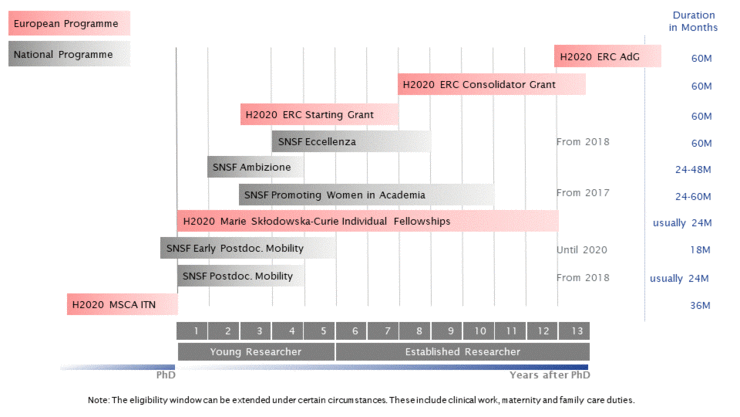
Now to get an idea of which grant one can apply through the difference phases of an academic career in Switzerland, I recommend this nice visual from the Euresearch team:
On this graph one can see both the national grants from the SNF (in gray), and the European grants (in red). If you’re a PhD student close to finishing, you can see that the SNF has Postdoc Mobility grants, or that you could apply for a Marie-Curie European fellowship.
What is Euresearch?
Euresearch is the “Swiss guide to European research & innovation.”
“Euresearch is a non-profit association with offices in all the Swiss regions and a Network Office in Bern. It is supported by the Swiss federal government to inform, advise and connect researchers based in or coming to Switzerland.
The objectives of the Euresearch Network are:
– to facilitate a high Swiss participation in the EU Framework Programme for Research and Innovation in accordance with the national Research, Development and Innovation (RDI) policy, either directly via the Euresearch Network or indirectly via intermediaries
– to ensure excellent proposals by focusing on the researchers with the highest potential”
Oh wait, if you’re already in Switzerland you probably know what the SNF is, no need introduction here 😉
Just one point I would like to highlight: on their website they have a nice “Selection guide for funding schemes” tool to help one find which grants they are eligible to, depending on the career status, discipline, and type of desired funding. Try it and learn about the many funding schemes the SNF has!
One more interesting website to explore about research in Switzerland is myScience.ch.
“myScience® is a career and information portal for scientists, specialists and engineers in Switzerland.
myScience.ch gives an overview of science and research in Switzerland. myScience.ch is intended for researchers, scientists, engineers, academics, and everyone interested in science. myScience.ch provides scientific news and events, as well as practical information on employment, funding and daily life in Switzerland, science jobs and continuing education portals.”
There are indeed many things to explore on this website, starting from its job portal and its info about both academic and non-academic careers. In particular, they have info on funding opportunities in Switzerland including from (private?) foundations.
To try to understand the different academic positions in Switzerland, have a look here, here and here. (Disclaimer: information on the internet can quickly be outdated.)
Here some good-to-know for PhD students, postdocs and all level of academics facing unemployment in Switzerland, but also for masters and any highly qualified person.
First some words about unemployment in general and the ORP/RAV, then about the BNF.
1) Unemployment and ORP/RAV counseling
Disclaimer: please make sure to check out the linked websites and to double-check how things work in your canton/city.
First important info: in order to receive the unemployment insurance (i.e. money) right after your contract’s end without a gap, you need to start applying for jobs before your contract ends. Plus you need to keep proof of all these applications. For example, if you are in Fribourg with a fixed-term contract (i.e. CDD in French), you need to have sent 2 to 3 applications per week for the last 3 months before your contract’s end.
Once registered to unemployment services, you will be assigned a counselor in a Regional Employment Center (acronym ORP in French, RAV in German). This person is here to help you find a job.
I can’t guarantee that this is always the case, but your counselor is likely to help toreview your CV and prepare for interviews, they might also offer to register to coaching sessions or specific training courses.
So please make sure to ask what support and training you can benefit from, and whether you can benefit from the BNF 👇
2) The BNF
If there is one program every academic in Switzerland should know about, this is the one: the BNF = National Qualification Programme. (The BNF acronym comes from the German.)
This program is here specifically to help you: a highly qualified person.
“Our consultants have similar professional backgrounds to the people they work with.”
“BNF is active throughout Switzerland and has 20 years of experience in supporting academics. We assist highly qualified specialists at career crossroads through personal counseling, fostering professional networks and focused training so that they can successfully place their professional know-how and skills in the job market. We provide:
– Personal information and advice (consulting)
– Professional networking through project work in the future job market (networking)
– Focused training / coaching in the application process (promoting)”
There are two main reasons why this program is so important and helpful.
The first one is that these are immenselykind and respectful professionals who will listen to you, review your professional profile together with you and empower you in your job search. From a couple of people I know who had the chance to benefit from the BNF, they all talk very highly of the support they received 🙂
The second one is that your BNF counselor will help you find an internship called a project work of 3 to 6 months in a company or in the public sector of your choice for you to gain professional experience in this specific type of company/institute which you want.
Not only will you gain a professional experience and new skills to put on your CV, you will also meet new people and extend your network, strongly increasing the chances to find a job.
In other words: let’s say you are a freshly graduated PhD in biology and you would like to transition to biotech industry but you are not receiving positive answers from your applications. Well, the BNF could help you get a project work in such company allowing you to put a first step in the door 🙂 If you’re lucky, the company might offer you a position (this does happen regularly, just check out their statistics in their last bulletin here, in DE and FR), or at least you will have gained professional experience, new relevant skills and developed your network to open other doors.
During such BNF project work, it is the unemployment insurance which is paying you. Meaning the BNF is working hand-in-hand with your ORP/RAV counselor.
Also, if you happen to be offered a position in the company or another one while you are doing a project work, you can quit any time and jump on that opportunity.
In addition, the BNF offers further coaching and specific courses like Project Management, Regulatory Affairs, Networking, Negotiation, Intellectual Property and many more. Check out their full list here!
Just to clarify: this program is not only for academics, it is for anyone with high qualifications or expertise, including all High Education School in Switzerland (Hautes Écoles, etc.)
Hoping it gives you new hope for your job search, thanks for reading this post today 🙂
If you know people who are unemployed or reaching the end of their contract, make sure to share these info with them 👍
In most (probably each?) Swiss universities there is a Gender Equality Office (“Bureau de l’égalité” in French) with specific programs and actions to promote gender equality, make sure to check out what’s available in your uni.
In addition, there are some programs between several universities or institutes and which are really specific for promoting women in academic careers. Here I am listing the three programs which I know about: two are for the universities in Western Switzerland (Suisse Romande), while the other one is for ETH institutes like the EPFL and ETHZ. 👇
Importantly, these programs are not only for PhD students but also for more advanced researchers.
When I was a PhD student, I didn’t feel welcomed by the academic system (not because I’m a woman but in a general way), making it hard to see myself making a career into it. I believe such programs can make this academic system much more welcoming, please don’t hesitate to take advantage of the help which is offered to you, don’t miss such an opportunity 🙂
“The transversal skills workshop program for women researchers”
Have a look at their Facts and Figures: “The REGARD workshop program is open to female researchers, i.e. assistants, PhD candidates, post-doctoral fellows, lecturers, MERs and other intermediate staff members, as well as female professors. Since 2016, some workshops have also been open to men.”
“The REGARD program offers workshops for female researchers and professors from the Universities of Fribourg, Lausanne, Geneva and Neuchâtel, as well as from the HES-SO and EPFL. More than 20 workshops tackle academic career planning, research project management, communication tools and personal development.”
“The Réseau romand is a mentoring program for the next generation of women. It helps female researchers in resolving all issues related to academic life organization as well as their scientific project’s completion.”
“The mentoring program is for advanced female doctoral, postdoctoral and researchers just before transitioning to professorship.”
“The program is organized in cooperation between the Equal opportunities offices of the Universities of Fribourg, Geneva, Lausanne, Neuchâtel and the EPFL.”
Have a look at their Facts and Figures: “Since the first edition of the Réseau romand in 2000, 234 mentees have participated in the mentoring program. They have been supported by 187 mentors from all Swiss universities, EPFs as well as foreign universities.”
“The aim of the program organized by all institutions of the ETH Domain is to support women in their scientific careers and in the process to fix the “leaky pipeline” of women in science.”
“The Fix the Leaky Pipeline program offers young female scientists (doctoral students, postdocs and other young scientists) the opportunity to reflect on their professional situations, to develop a strategy for embarking on or continuing their career paths, to receive targeted further training, and to extend their personal and scientific networks.”
They are offering courses on subjects like career planning, leadership, self-marketing, and they also have a coaching program and a mentoring program.
—
NB: Some uni also have their own women academic career program like:
Here I’m repeating myself from a previous blog post, but I think it’s good to put these specific info here again.
In each Swiss University, also in EPFL and ETHZ (and probably other institutes too), there is at least a Career Center for students. However, rumors are that often (but not always) such career centers are very good at helping bachelor and master students, but maybe not that experienced with PhD students, not mentioning postdocs… That being said, I think it is unacceptable that ECR* are forgotten from such university services.
ECR = Early Career Researchers (i.e. PhD students and postdocs)
Thankfully, in more and more Swiss uni and higher education institutes, there are now career services specific for ECR which are being developed. This can come as a “Graduate Campus” or sometimes it is postdocs who started organizing the help they needed through a postdoc association.
What can these Career Centers or ECR-specific Services offer you? Each one will have its own agenda, but in summary you should be able to find: free CV check, counseling, training for job interviews, access to career development workshops and other transferable skills workshops, and sometimes even coaching.
Have a look at what’s available in your city with the list below, and make sure to ask your colleagues about what else is out there for you.
Disclaimer: I don’t guarantee the list below to be complete.
Basel
GRACE Graduate Center for Doctoral Candidates and Postdocs
Here their website.
“GRACE offers services and information, supports networking and interdisciplinary training formats and prepares doctoral candidates and postdocs for future challenges inside and outside academia.”
A beautiful website with lots of information and with subsections specific for PhD students, for postdocs, for supervisors, and they also have a program to support women careers.
Career Service Center including for PhD students
Here the Career Service Center website.
“We offer our Bachelor, Master and PhD students, as well as recent graduates, various services and support them in getting started in the working world. Our services include workshops, counseling sessions, MEET&CONNECT events and much more. All of this is designed to provide students with extra information or guidance on topics revolving around job applications, career planning and career opportunities.”
Bern
Career Service for PhD students
Here the website.
“Do you already want to actively prepare for you professional career while studying or preparing your PhD? We support students and doctoral students at the University of Bern in their transition from studies to professional life. Learn more about current courses, find out all you need to know about applications and your career start, discover opportunities to make contact with attractive employers and find job vacancies.”
COMET Career Program for Women Postdocs
Here their website. “Coaching, Mentoring, Training for female researchers”
“The University of Bern’s career programme is part of the strategy for 2021 of the University of Bern. It complements the university’s already existing mentoring programmes and is aimed specifically at female postdoctoral researchers of all faculties.”
Fribourg
Here the website of the Career Center including for PhD students, at the University of Fribourg.
Unfortunately (as of September 2019) the website works only in French and in German…
They can help with CV and cover letter writing, to elaborate a career project, to prepare for job interviews, they also organize workshops.
“Les Career Services soutiennent les étudiant-e-s et doctorant-e-s dans le passage des études à la vie active en dehors de l’Université. Le terme « carrière » revêt pour nous une connotation neutre. Nos coachings individuels, ateliers et événements en réseau mettent tous l’accent sur l’épanouissement professionnel individuel.”
Geneva
Career Center DIFE
Career Center in the DIFE (Division de la Formation et des Étudiants).
Their website seems to be only in French but they do offer some workshops in English, they have information specific for PhD students here.
APDU - Post-Doc Association
Checkout their website here, their mentoring program and other useful information here.
“We are a group of motivated PostDocs from the Faculty of Sciences at the University of Geneva. The goal of our newly-formed association is to strengthen social and scientific ties between us, here at UNIGE, and to promote career development for postdocs by organising a mentoring program, academic meetings and career forums. We are open to all Faculties and Disciplines at the University of Geneva. Join us!”
Lausanne
UNIL Graduate Campus - for PhDs and postdocs
Here for the unil website and here their list of activities on their independent website.
“The University of Lausanne offers a number of workshops designed for doctoral candidates and postdocs of all faculties.”
“The Graduate Campus provides career guidance and counseling, whatever the path chosen.”
UNIL Orientation and Career Service (SOC)
Here their website, which seems to be only in French.
They offer services like “coaching emploi,” individual coaching, and “bilan de compétences.”
EPFL Career Center
EPFL Career Center
“We regularly schedule workshops and seminars on topics such as CV writing, job interview preparation, LinkedIn, assessment centers, salary negotiation, networking, etc.”
Luzern
Here the website of the Graduate Academy of the University of Lucerne. As of September 2019, this Graduate Academy seems in its early stage of development and it promises to be a great service for ECR in this uni, so nice to see such project being developed!
“The Graduate Academy is open to all (post-) doctoral students at the University of Lucerne and is currently being built up as a contact point for our University’s junior researchers.”
“Offers by the Graduate Academy, such as the Generic Skills course program, provide an additional framework for training and support (post-) doctoral students on their way to a future career – be it in academia or outside”
Neuchâtel
Here the website of the University of Neuchâtel Career Center which seems to be only in French but they do have a page for PhD students with a lot of useful resources both for academic and non-academic careers!
“Après l’obtention de votre doctorat, vous pouvez choisir de continuer votre carrière académique (postdoc ou expérience postdoctorale) ou en sortir, et chercher un travail dans l’économie privée ou publique ”
St Gallen
Here the website of the Young Investigator Program of the University of St Gallen.
“We support young researchers to develop interdisciplinary competencies, to become familiar with the academic system, and to tackle questions and conflicts that may arise during qualification and career planning.”
Zurich
UZH Graduate Campus - for PhD students and postdocs
Here the website of the Graduate Campus, and here to their Career Services, it seems like they are currently working on a new career platform.
“Graduate Campus is a one-stop source of information and activities for PhD candidates and postdoctoralresearchers at the University of Zurich. A variety of courses and events provide opportunities to gain further qualifications, engage in research-relevant topics and exchange insights and ideas with peers.”
They have a counseling service, career planning guides, a drop-in service every Thursday to check your CV and application materials, and more.
ETHZ Career Centre and Recruiting
Here their website.
“We support students and doctoral students through various career services for the transition into the professional world.”
ETHZ Human Resources courses
Here they have courses on themes like leadership, project management for research, career, and health promotion.
I hope this helps to make visible the services which are here to help regarding your career questions. Don’t stay alone with your doubt, take the first step to your own journey and get in contact with these people 🙂
If you happen to have already left your university and if you are currently unemployed in Switzerland, here some words about the BNF program which could help you greatly in your job search.
Also checkout my previous blog post listing free online tools for self-assessing your skills, interests and values and all my #career posts!
Stay tune for my next blog posts, I’ll have more resources about careers for ECR in Switzerland! To receive it directly in your emails, sign-up below!
Recently, quite a few PhD students whom I know from my former university (Fribourg, Switzerland) are graduating and when chatting about their “what next?”, I found myself recommending the same websites again and again. This is then the first article of a series about #career which all together will create a long resource.
Most articles are specific for Switzerland and should be of interest of both PhD students and postdocs (PhDs). Also, as I come from life sciences, I have a bias towards STEM* but many of the info I’ll share should be interesting whatever your field.
👉 In this first article, you find a list of websites to help you identify your own skills, interests and values. “Collect data on yourself before choosing a career” have a look at this nice 2015 article from Nature Careers about the importance of using the tools I link below 🙂
*STEM = Science, Technology, Engineering, Mathematics (Life Science is in here too).
This has been developed by the journal Science and their Science Career team since 2003 (yes, 2003!!).
“You have put a lot of time and effort into pursuing your PhD degree. Now it’s time to focus on how to leverage your expertise into a satisfying and productive career. The Individual Development Plan (IDP) concept is commonly used in industry to help employees define and pursue their career goals. In 2003, the Federation of American Societies for Experimental Biology (FASEB) proposed an IDP framework for postdoctoral fellows in the sciences. AAAS/Science joined forces with FASEB and experts from several universities (see authors below) to expand on that framework. The result is myIDP – a unique, web-based career-planning tool tailored to meet the needs of PhD students and postdocs in the sciences.”
Here you will be asked to fill up 3 questionnaires for self-assessing:
your skills (exampe: How is your level for writing scientific publications on a scale of 1 to 5?)
your interets = the things you like to do (example: do you like writing scientific publications?)
your values (example: how important is it for you to “have some choice over the hours or days that [you] work”?)
Then based on your answers, this IDP tool will match a list of career paths (academic and non-academic) and for each they’re having resources with blog posts, articles, books, etc. for you to explore further.
I’ve done it a couple of times for myself, I highly recommend it! 🙂
SSH = Social Sciences and Humanities. However, I also recommend it for STEM in addition to the myIDP, because ImaginePhD also has tons of resources to explore and I find the values assessment questionnaire and results more complete (plus the website is all new and beautiful).
“Following a similar process that resulted in the creation of the myIDP online career tool for STEM fields, the ImaginePhD team engaged “experts” to complete surveys to gather data to match skills and interests to sixteen job families.”
“ImaginePhD is a free online career exploration and planning tool for PhD students and postdoctoral scholars in the humanities and social sciences.
Humanities and social sciences PhD students and their mentors have long recognized the need for more resources to help bridge the knowledge gap between doctoral education and the realm of career possibilities. ImaginePhD is designed to meet this need by allowing users to:
assess their career-related skills, interests, and values
explore careers paths appropriate to their disciplines
create self-defined goals
map out next steps for career and professional development success”
Quickly first about Vitae: “We are a non-profit programme, part of The Careers Research and Advisory Centre (CRAC) Ltd with nearly 50 years’ experience in enhancing the skills and careers of researchers”
I have been recommended Vitae and the work they do quite many times, specifically their Research Development Framework to help us reflect on our own skills.
However, given that their online planner is not free, I haven’t tried it yet… I should do this soon 🙂
Now about the RDF Planner: have a look at their nice presentation video.
“Take control of your professional and career development with the Vitae RDF Planner
Identify your expertise and capabilities
Plan your career
Focus your training effort where it is needed most
Record and showcase your achievements
Monitor your progress
Use in professional development review meetings with your supervisor or PI”
mydocPro (France)
Here the website. While originally from France, this website exists in English as well.
It’s free.
This online tool guides you step by step to reflect on your skills and to build your portfolio. It offers to create an online profile by adding the skills which you think you have. However, compared to myIDP or ImaginePhD for example, here there are no questionnaires. You will have to judge your own level for each skill. Thus, it’s likely to be subjective, but it’s still a good tool to use.
In particular, what I like on this website is that for each skill it encourages to write a short paragraph to describe how you acquired this skill. Taking the time to write this down will be a great advantage for when you are in a job interview and someone ask, for example, “how do you manage conflict?” Read more about this idea of portfolio here and here.
At the same time, you are creating an online profile meaning you are visible to potential employers and you can look for jobs on their platform (for industry).
“DocPro provides you with a clear and well-structured vision of the skills you have to offer an employer. It is a tool for analysis, self-assessment and communication that will help you prepare for a career move and capitalize on your skills.”
“The application guides you step by step to:
identify the competencies you wish to highlight;
determine your progress with respect to the three phases of maturity defined by the tool;
illustrate each skill you list with a personal experience that shows specifically how you acquired it;
upload your profile to be shared on mydocpro.org.”
I signed up to Twitter somewhere in the middle of my PhD studies and it was like discovering a new world. It actually helped me feel better as I discovered all these people sharing their difficulties in academia and sharing so many tips. It’s also a great platform to follow academic news and even academic positions offers. However, like the famous account Shit Academics Say summarized in one tweet, each social media has its own bias and Twitter tends to have a lot of negativity and political voices:
Academic social media
Google Scholar: I am my h-index ResearchGate: Give pdfs back pls Academia. edu: Give time back pls Instagram: My desk & wine glass y’all Snapchat: ¯_(ツ)_/¯ LinkedIn: Low key leaving my uni Facebook: Everything is great mom Twitter: Burn it all down
Therefore, my most important tip for Twitter is to compensate the overwhelming academic stuff by following accounts like @EmrgencyKittens or @EverythingGoats, you’re welcome! 🙂
Second important tip is about one feature that I overlooked myself for a long time: Twitter lists! Indeed, with time my Twitter became a mix of so many different information that I sometimes lose sight of what I really want to see, like the people I want to follow closely and the news that are more closely related to my university. Now I see a Twitter list just like a folder where I add the accounts related to one particular interest of mine. Lists can be private or public.
The account Shit Academics Say @AcademicsSay is not only one of the most famous academic accounts to follow (over 300k followers as of May 2019), but is also a social experiment by Prof. Nathan C. Hall (@prof_nch ) who is a professor at the McGill University in Canada studying Achievement Motivation and Emotion in academia. His @AME_Research group published many interesting papers and long reviews. In particular, they published a large review entitled “The PhD Experience: a review of the factors influencing PhD students’ completion, achievement, and well-being” (Sverdlik et al., 2018) but it is so long that most of you won’t read it, so I wrote a highlight of it here in my blog, you’re welcome again!
@SwissEuresearch = “Euresearch is the Swiss information and advisory service on the European Research and Innovation Framework Programmes.” sharing info about Horizon2020, Marie Curie Actions, and other European research programs.
Like mentioned in my previous article about Instagram for PhD students, one difference between Instagram and Twitter is that on Instagram you can follow hashtags easily while on Twitter you can’t. To help with that, some accounts are manually or automatically retweeting tweets with some specific hashtags.
The account @AcademicChatter is playing a key role in the success of #PhDchat and is not a robot, people can now even take over the account for one week to discuss their own subject of interest. A must follow!
Very happy to have hit 15k followers in just over a year and a half. My aim was to create an account that would help facilitate connection, support, and awareness for students and ECRs, I think we’re on our way to fulfilling that. Thank you all, stay kind and supportive 🙂 Jon pic.twitter.com/PeEugICCs8
Hi #AcademicTwitter: What is something that you didn’t receive formal training on, but that you view as very important to success & survival in your academic career?
Some of mine:
– navigating coauthor relationships
– project management
– mentoring
Combining information from different websites and things I knew about, I’ve put together a list of graduate centers, career centers and transferable skills (soft skills) programs for PhD students and postdocs in Switzerland. Initially I was only looking for information for PhD students, but as my search results were often concerning postdocs too, I believe that the list below is also of interest for postdocs.
Hoping this resource will help PhD students and postdocs in Switzerland to find support networks and training to help them thrive in academia.
Basel
GRACE Graduate Center for Doctoral Candidates and Postdocs
A beautiful website with lots of information and with subsections specific for PhD students, for postdocs, for supervisors, and they also have a program to support women careers
“We offer our Bachelor, Master and PhD students, as well as recent graduates, various services and support them in getting started in the working world. Our services include workshops, counseling sessions, MEET&CONNECT events and much more. All of this is designed to provide students with extra information or guidance on topics revolving around job applications, career planning and career opportunities.”
Bern
PhD students can also access the CUSO transferable skills program (see the Western Switzerland part below).
“Do you already want to actively prepare for you professional career while studying or preparing your PhD? We support students and doctoral students at the University of Bern in their transition from studies to professional life. Learn more about current courses, find out all you need to know about applications and your career start, discover opportunities to make contact with attractive employers and find job vacancies.”
Here their website. “Coaching, Mentoring, Training for female researchers”
“The University of Bern’s career programme is part of the strategy for 2021 of the University of Bern. It complements the university’s already existing mentoring programmes and is aimed specifically at female postdoctoral researchers of all faculties.”
“The intermediate staff consists of all doctoral (PhD) students, assistants, postdocs, lecturers and other academic staff with the exception of professors.”
Here the website of the Career Center of UniFr, unfortunately (as of September 2019) the website works only in French and in German… They can help with CV and cover letter writing, to elaborate a career project, to prepare for job interviews, they also organize workshops on these subjects. It is situated at the Centre Fries, just like Uni Social.
Uni Social can provide you with individual coaching, with support to help with CV writing and job applications, with support in case of conflict (mediation office) and even psychological support as I talked in this previous blog post about a PhD student friend’s mental health difficulty at UniFr.
The CSWM is the association des Collaborateurs et collaboratrices scientifiques / Wissenschaftliche Mitarbeiter und Mitarbeiterinnen of the University of Fribourg.
Their website is either in French or German but they link to this part of the UniFr website which is available in English and which has information for PhD students and postdocs.
Geneva
Career Center DIFE
Career Center in the DIFE (Division de la Formation et des Étudiants).
Since 2018, the Faculty of Sciences and Medicine created a PhD School of Life Sciences (PSLS). Checkout their beautiful website here with precious information about available courses, in particular this PDF, and helpful FAQs.
“We are a group of motivated PostDocs from the Faculty of Sciences at the University of Geneva. The goal of our newly-formed association is to strengthen social and scientific ties between us, here at UNIGE, and to promote career development for postdocs by organising a mentoring program, academic meetings and career forums. We are open to all Faculties and Disciplines at the University of Geneva. Join us!”
“The Generic Skills courses are directed towards students who are doing a doctorate/PhD as well as the mid-level faculty and is free of charge for them.”
Neuchâtel
Career Center and ACINE Intermediate Staff Association (Association du corps intermédiaire de l’Université de Neuchâtel).
“We help future researchers build interdisciplinary competencies, get to grips with the academic system, and tackle questions and conflicts that emerge during qualification and career planning.”
“Our PhD-Writing Groups offer you regular time and space for writing your PhD thesis or related papers.”
Zurich
UZH Graduate Campus - for PhD students and postdocs
“Graduate Campus is a one-stop source of information and activities for PhD candidates and postdoctoralresearchers at the University of Zurich. A variety of courses and events provide opportunities to gain further qualifications, engage in research-relevant topics and exchange insights and ideas with peers.”
“The Association of doctoral students, post docs and scientific employees of the University of Zurich, is here to represent the interests of the academic mid-level staff vis-à-vis the University and the public. On this site you will find relevant information about the VAUZ, our political activities and our services.”
Here to their “coaching, consulting and counseling” service.
UZH Career Services
Here their website. They have a counseling service, career planning guides, a drop-in service every Thursday to check your CV and application materials, and more.
“We support students and doctoral students through various career services for the transition into the professional world.” and their counseling service.
ETHZ Human Resources courses
Here they have courses on themes like leadership, project management for research, career, and health promotion.
Western Switzerland / Suisse Romande
BADOC for the HES-SO
Seems to be only in French.
Ici le site du BADOC = Bureau d’appui et de coordination de la formation doctorale pour les HES-SO = Hautes Ecoles Spécialisées de Suisse Occidentale.
“En collaboration avec l’Université de Lausanne et plus particulièrement son Graduate Campus- le BADOC propose un soutien et des ressources aux différentes personnes impliquées dans la formation doctorale à la HES-SO. Il offre en outre une plus grande visibilité aux recherches menées par les doctorantes et doctorants dans les différentes hautes écoles. Le BADOC tient aussi lieu de veille scientifique en matière de pratiques effectives de direction de thèses et de développement professionnel des chercheur-e-s en début de carrière.”
CUSO Conference of Western Swiss Universities - for PhD students
“The transversal programme is intended for doctoral candidates enrolled in any of the CUSO doctoral programmes. It offers a diverse range of workshops to help you develop your transferable skills.”
The CUSO is also organizing the Swiss MT180 contest (Ma thèse en 180secondes).
REGARD Network for women in research - for PhD students, postdocs and higher
“The transversal skills workshop program for women researchers”
“The REGARD workshops offer you concrete tools for your academic career management – whether you are a PhD candidate, a member of the mid-level faculty or a women professor.”
“The REGARD program offers workshops for female researchers and professors from the Universities of Fribourg, Lausanne, Geneva and Neuchâtel, as well as from the HES-SO and EPFL. More than 20 workshops tackle academic career planning, research project management, communication tools and personal development.”
Women Mentoring Network - for PhD students, postdocs and higher
“The Réseau romand is a mentoring program for the next generation of women. It helps female researchers in resolving all issues related to academic life organization as well as their scientific project’s completion.”
ETH Domain and Women in Science – Fix the Leaking Pipeline
“The aim of the program organized by all institutions of the ETH Domain is to support women in their scientific careers and in the process to fix the “leaky pipeline” of women in science.”
“The Fix the Leaky Pipeline program offers young female scientists (doctoral students, postdocs and other young scientists) the opportunity to reflect on their professional situations, to develop a strategy for embarking on or continuing their career paths, to receive targeted further training, and to extend their personal and scientific networks.”
They are offering courses on subjects like career planning, leadership, self-marketing, and they also have a coaching program and a mentoring program.
“The Swiss Transferable Skills Network began in 2014 and is composed of the managers of transferable skills training and career development for junior researchers (primarily doctoral candidates and postdocs) from across the Swiss university system. It currently includes representatives from the Universities of Basel, Bern, Fribourg, Geneva, Lausanne, Lucerne, St Gallen and Zurich, the ETHZ and EPFL, the CUSO and Regard (Bureaux de l’égalité) programmes in western Switzerland, as well as representation from swissuniversities.”
Fix the leaky pipeline - useful links page
While this program is organized by ETH institutions in Switzerland, on their page “useful links” they link to many other Women in Science or science-related programs (like the SNF) in Switzerland but also in Germany, Austria and within the European Commission.
The actionuni association, representing research staff from all Switzerland
“[actionuni] represents young researchers as well as the associations of non-professorial academic staff of the Swiss cantonal universities, the Federal Institutes of Technology, the Swiss Universities of Applied Sciences, and the Swiss Universities of Teacher Education on the Swiss national as well as the international level. actionuni’s objectives are to improve the academic career tracks and to coordinate the activities of the Swiss associations of non-professorial academic staff.”
Resources page on portfolio-formation.ch by Dr.Verity Elston
Dr. Verity Elston is actively involved in transferable skills programs in Switzerland (CUSO, Lausanne Graduate Campus).
In her resource she’s linking to many good websites to find PhD students’ advice, for looking for jobs, and she was the first one to make a list of career centers and graduate programs in Switzerland.
Thanks for looking through this resource. I hope you found helpful information and please help other students and postdocs in Switzerland to find these information by sharing this resource around you 🙂
And if you know of more graduate centers, career programs or soft skills programs for PhD students and postdocs in Swiss universities, please let us know in the comment below 👇
Last week first with YouTube, I started making resources of social media and other online materials which seems to me as relevant to the PhD student experience, for today I looked into Instagram!
I hope you will find below some interesting hashtags # and people @ to follow 🙂
Actually, I’ve never looked much at Instagram before and it’s like I’ve discovered a whole new world. I can see the differences with Twitter and see how each has its advantages and disadvantages. I like that in Instagram you call follow a hashtag (can’t do that in Twitter), and I like that people’s streams are much cleaner in Insta as there is no RT.
If I’ve missed some hashtags or someone essential to follow, just let me know in the comment below and I’ll have a look 👇
“academia” doesn’t work as a good hashtag for the academic world as it seems to be used by people who either work out a lot or play video games, better hashtags then would be: #instaresearch and simply #research
Interestingly enough, “#lablife” results in a lot of dog pictures 🤔 It looks like on Instagram lab = Labrador ≠ laboratory, on Twitter you get a funny mix of both.
@LegoGradStudent, A PhD student who reproduces scenes from his PhD life with Legos with an impressive level of detail, it’s both beautiful work and full of dark humor, I love it!
=> for me it was “yay no students in the uni restaurant, no queue to get food \o/”
Ph_D_epression
@ph_d_epression is a “Collaborative Community Discussing #MentalHealth in Higher Ed”
Featuring stories from academics struggling with stress, anxiety, depression and all form of mental health difficulties, also sharing tips and advice like below, I seems to me like the new “must follow” for all academics.
@phd_sos is an “account run by PhD Graduate 👩🏻🎓/Previous Faculty Member 👩🏻🏫/ Be a part of the PhD SOS Community 👩🏻💻 Connect / Communicate / Sharing Tips & Advice”
A community account sharing tips and advice, I like that they’re having pictures with the community answers from one question, for example:
@proud.nerd.for.life a “PhD student, here to support other panicked and procrastinating researchers with pearls of wisdom – and humor- about life in academia.”
“We have compiled a list of our top science Instagram influencers. Their photos range from shots of specimens under a microscope; recordings of their travels across the world; personal posts documenting their PhD journey; to scientific concepts explained using sushi!”
The thumbnail picture of this article is courtesy of my partner in life.
Are you feeling lonely in your PhD life? Unfortunately if you’re in academia, I’m afraid that chances of feeling lonely, lost and overwhelmed all at the same time are quite high. I hear you, I’ve been there.
The good news is, actually, there are tons of materials online from people sharing their own ups and downs of doing a PhD. The bad news is, there are tons of materials online: videos, podcasts, Facebook groups and pages, the whole Twitter, and Instagram! Without mentioning all the journals, blogs and websites…
SO… I thought I will make some resources to help find such materials, selecting those which seem to me as relevant to the PhD student experience. I’m not saying that I will make resources for all of these media types, but I’ll try my best and see what time brings us.
So for today, let’s start with YouTube!
I remember how I randomly came across some of these videos during my PhD studies and how it made me feel a bit better 🙂 Thus I hope you can also find some inspiration from these PhD students’ vlogs and videos, from these TEDtalks or from these two musicvideoclipparodiesbelow. I know there is MUCH more out there, I only selected the ones which I found while researching for this resource and which I liked, no offense.
YouTube Channels
Ava Mason
Update October 2020: Ava recently contacted me to let me know about her YouTube channel and I thought it would indeed be a great contribution to add to this resource! In particular, because Ava is at the very beginning of her PhD and I look forward to following her journey!
She is starting a PhD at UCL (UK), in addition to being a research assistant at Kings (UK), in psychiatry.
If you are also starting a PhD, you can follow Ava’s journey at the same time as you go through your own!
The PhDiaries
Update October 2020: it looks like Lucy has finish or is very close to finish her PhD, she already got her next job and she made a nice video about “Academia: Stay or Go?” ! Congrats!
Lucy is a PhD student at the University of Oxford (UK):
“The PhDiaries is a YouTube channel for PhD students to find advice, relatable misadventures, and comfort in knowing they’re not alone in their problems, all in under four minutes and usually once or twice a fortnight.”
He finished his PhD about a year ago from the University of Exeter (UK), Simon has been posting videos since a long time and is quite popular given the number of subscribers. Throughout his PhD he maintained a vlog, but he also has additional interesting videos like for example here when looking back at his PhD experience: “Pros and cons of doing a PhD (personal experience)”
Olivia's Grad School Vlogs
Olivia started grad school about one year ago so if you’re also in the beginning you could be going through this together. Olivia is studying at Penn State’s College (US).
This one is not a one-person channel and is not from PhD students.
Here are videos from researchers and professors towards PhD students and other early career researchers:
“an online resource for graduate students, postdoctoral scholars, and junior scientists to navigate their path and learn from the experiences of others. Faculty members and scientists in the fields of chemistry and chemical engineering are invited to share their tips on developing a successful career. We have presentations on 3 categories: technical skills, soft skills, and health in higher education.”
TED global: Why Science Demands a Leap into the Unknown, by Uri Alon - 2013
Dr. Uri Alon is a professor in Systems biology. In this talk he reflects back on his own PhD experience and about what kind of advice he gives to his students today when they feel stuck in their projects.
Can’t insert the video here for some reason, you’ll need to click the link ☝️
TEDx: The Reset Button: The Great Fantasy of Academia - 2015
A nice 15-minute talk reminding that it’s not so much the grades which matter rather than the capacity to study and to master a subject.
TEDx: Reimagining the PhD – 2014
A PhD student in the US sharing how she figured out what career path to follow and how with her fellow students they organized group sessions to work on this together, starting with self-assessment tests and taking on action outside their lab to develop their skills.
I find it quite inspiring to see how the students themselves created their own career development program.
Music video clip parodies
Postdoc Me Now - A 'Don't Stop Me Now' Science Parody - 2018
Please if you have recommendations of videos to add here, just let us know in the comments below or shoot me an email and I’ll have a look, not promising anything! In particular, I would love to know about YouTube channels others than from the US and the UK, but it should be in English, or in French (’cause I’m French), thanks!
BTW, you know how to speed up YouTube videos, right? You can probably watch all the videos above at speed 1.25 or 1.5, if you’re short on time.
This article is not only a blog post but also a resource linking to other good blog posts and to free downloadable templates of project management tools for PhD students and supervisors.
To create this resource I asked around me and on Twitter if people had good references. I got a few nice ones, but actually I got many suggestions about self-organization and time management. It then appears to me that we tend to mix up what project management is versus time management, and even for me today it’s still not 100% clear.
In this research and student-supervisor relationship context, I would like to suggest the following:
time management is a personal skills: you manage your own time, you decide what to do Tuesday at 10 AM, maybe you agree to meet with someone at this time, but ultimately you’re the one who decides when for example you want to have lunch or coffee (at least I hope you can). This also means that, to some extent, it doesn’t matter if your time management style does not align perfectly with your colleagues. Again, I wrote to some extent.
on the other hand, for project management and in this context, there are at least two persons involved: the student and the supervisor. In my views, project management is as much about planning and conducting a project as about finding a compatible way for two persons to work together. Project management is a team skill.
Therefore, what I’ve been looking for are references to help both PhD students and supervisors to first understand what the underlying principles of project management are, and secondly to get an overview of different tools available to help them work together.
Below you will find interesting blog posts, whenever possible I selected those giving concrete advice on how to implement project management in research, and I also looked for free ready-to-use templates.
Click on each drop-down item below to see the content.
1. Understand the underlying principles of project management for researchers
This article tries to define what project management is, argues that it can be applied to research and introduce the principles for how to do so:
“Projects can be large or small, planned and tracked formally or informally, and defined by a legal contract or an informal agreement.”
“Project management allows–indeed, insists–that the components of a project be constantly revised as new information arises.”
“The greatest chances for project success are realized when PIs, acting as managers, embrace the following premises. Project management is a way of thinking and behaving, rather than just a way of analyzing and presenting data.”
How Project Management Techniques Can Improve Research - blog post
“research project management as a subdiscipline that can provide the tools and resources for researchers to better organize projects, but with flexibility in the planning process to evolve with the project as needed”
“Creating a road map to guide successful project implementation create a culture of shared ownership toward research goals and open communication throughout the project life cycle.”
There is a recommended reading list at the article’s end.
A PhD as a project - blog posts
from Fiona Saunders on her website and on the Thesis Whisperer website in 2013
meant toward PhD students
Introduction from the Thesis Whisperer: “Fiona Saunders is a Senior Lecturer in the Management of Engineering Projects at The University of Manchester and a part-time PhD student. Her research interests are in the management of projects in safety-critical industries. Prior to academia, Fiona enjoyed a successful 15 year industry career in project management.”
“Having a documented PhD scope can help guard against a loss of focus, or drift in what the aims and objectives of the PhD are.”
“The third and final lesson from project management that is highly relevant to a PhD is the importance of communication.”
“One of the hardest lessons for new PhD students to learn is that the PhD is your project as such you are the project manager and you must take responsibility for managing the various communication channels on the project.”
The Smart Way to Manage a Large Research Project - blog post
Tips on project management and also to manage data and files. Plus the article acts as a resource with an extensive list of tools to help you get organized.
“Planning consists of the following subtasks:
Identifying the tasks that need to be carried out.
Splitting the main tasks into their respective subtasks.
Considering how much time each task takes.
Determining which tasks run simultaneously.
Assess the consequences if a task takes more time.
Allow some air to breathe
Continuing the ideas to manage a large research project, regular checkpoints are an important aspect of a successful planning.”
meant toward postdocs and new faculty as the subtitle says
“Based on workshops co-sponsored by the Burroughs Wellcome Fund and HHMI, this book is a collection of practical advice and experiences from seasoned biomedical investigators and includes chapters on laboratory leadership, getting funded, project management, and teaching and course design.”
You can download each chapter as a PDF for free. Chapter 7 is about project management while Chapter 6 is about time management.
2. Get to know different project management techniques and tools
Gantt chart
PERT chart
Work Breakdown Structure (WBS)
SMART goal
Agile
Kanban board
Each tool has its pros and cons. Therefore, one could combine them on different levels. For example, to visualize a complete PhD timeline I would recommend Gantt charts. To make this timeline, using WBS and SMART goals will help break down the project into smaller achievable tasks. Then to implement work and to track the progress throughout the project, one could use the Agile principles and use a shared Kanban board.
I don’t pretend that this resource is complete, there is surely much more which I don’t know about. Nevertheless, this was done to the best of my knowledge and it includes the project management tools which I’ve seen the most often in academia.
Gantt charts:
Academiac - blog posts and template
With my complete unbiased objectivity, I think that my 2 articles about Gantt charts with a free downloadable template are the best ones to explain how to use these charts for a PhD project =)
In the first article, Are Gantt charts useful for PhD students?, I introduce what Gantt charts are and what are the drawbacks to keep in mind (i.e. lack of flexibility).
In the second article, Guidelines to draw a timeline of your PhD, I provide guidelines to use Gantt charts specifically to draw a PhD timeline and to use it throughout the PhD. In this article one can also download for free the Excel file I used to create the timeline.
This is a tool where you can drag and drop pictograms onto a 4-year calendar to create a road map for your PhD. They have signs for things like writing, conferences, meeting, holidays, risk analysis, etc.
The display is quite old fashion, but I like the idea of cards which one can drag and drop on the calendar. In a way it allows to create a simplified Gantt chart with the PhD main steps.
Templates for different PhD length by the University of Adelaide
“A Gantt chart helps you plan your activities, communicate with your supervisory team and the University, and helps you keep track of your progress.”
PERT charts
It happens that I don’t know much about PERT charts but I’ve seen it mentioned in many references (often together with Gantt charts) so I thought it would be good to put it here.
PERT charts - articles and templates
PERT means Program Evaluation Review Technique.
Like a Gantt chart there is the idea to draw a diagram for a project but instead of horizontal bars here it uses boxes and arrows. Again each technique has its pros and cons, have a look at these two articles to try to understand the differences between Gantt charts and PERT charts:
In this extensive article, they suggest a formula to calculate an estimate of how long a task might take:
“For each task, give three time estimates in days: the most optimistic completion time (O), the normal/most likely time (M), and the pessimistic time (P).
Calculate expected time (TE) using the formula (O + 4*M + P) ÷ 6 = TE.”
They also talk about PERT charts in the book Making the Right Moves chapter 7 (see above)
Work Breakdown Structure (WBS)
Work Breakdown Structure (WBS) - articles and templates
It is often recommended to first break a PhD project into small tasks and make a Work Breakdown Structure before making a Gantt chart or PERT chart.
“SMART objectives are Specific, Measurable, Achievable, Relevant, and Time-related.”
In this article, I like the idea that we should “use an action word to describe what you want to achieve. Using an action word makes sure that your goal is clear and measurable.” and that they provide a list of such action verb to use.
Agile
Briefly the Agile method is to define a concrete goal (like SMART goals) to reach in a short period (typically <1 month), to work hard and focus toward this goal (as a sprint), then to analyze results and define a new goal for the next short period. In particular, it promotes communication and forces to regularly get feedback from stakeholders.
An introduction to Agile and how she implemented the methodology in her PhD studies.
meant toward PhD students
“I’ve isolated a few key concepts that really challenged how I thought about my work and helped me build systems to move quickly and efficiently through the dissertation process.”
“In Agile systems, being adaptive is a core value that underpins so many of the actual day to day practices.”
“Having milestones like sprint goals ensured that I never got too far off track, and checking in every day gave me structure even when things were shifting, but Agile showed me that I could let the project evolve all while staying in control.”
A drawback of Agile
One potential drawback is that it doesn’t force people to look at longer time goals and that consequently one might lose sense of the bigger picture. From a video by Fiona Saunders
In my PhD studies, setting up short time goals like performing experiments x, y and z for the coming month was not the difficult part. What I missed was a sense of longer time goals and the big picture. This is why for me using Gantt charts to create a PhD timeline and promote communication between students and supervisors seems like the most important project management tool to implement.
However, we do need to consider the two scales: the project long-term goals/big picture, and the short-term goals which make the project move forward step by step. Therefore, using Agile and SMART goals in combination with a PhD Gantt chart does sound like a great way to grasp hold on both scale.
The Agile Approach with Doctoral Dissertation Supervision - Publication & model
In a Kanban board one creates different columns where tasks are placed depending on their status. The simplest way is with 3 columns To Do, Doing, Done but, of course, you can adapt this to your needs and I will even recommend having columns like Waiting For, or Someday/Maybe Ideas.
When you search for tips on how to create Kanban boards, it’s likely that you’ll be suggested the online tool Trello. I also use Trello a lot and love it, but there are other software available, also paper and pen is always a good way to start!
Live a PhD life less disorganised with Trello - blog post
“I’m an academic always looking for ways to manage my work and writing more effectively. I’m also in the thick of my PhD. For both of these I can recommend a very intuitive (and free!) web-based project management tool called Trello.”
“I then invited my supervisors (one of whom insists she is a technophobe) to access the Trello board, and waited to see what would happen next.
My supervisors took to the software like ducks to a pond.”
“I lead a team of 10–15 scientists and a nonprofit company. Over the past 15 years, I used various methods and tools to manage projects, keep track of the scientific work of doctoral students and postdocs, recruit dozens of people, and organize my own tasks in research, teaching, and administration.”
“I use group boards for all research projects and for some other processes with at least two persons involved, such as managing job applications.”
Progress tracking tool for managing PhD students - StackExchange
“I am looking for good options for tools to manage my PhD students, in terms of seeing that they are on track in working out their PhD theses (…) So some basic features would be:
Collaborative software (preference of hosted on a server)
Task lists with deadlines
Timeline progression”
and was recommended to use Kanban boards and Trello.
More ideas on StackExchange
More ideas of software and project management tools for researchers on StackExchange discussions:
There is not 1 and unique way to manage a project, everyone finds its own way, adapts it to the persons involved in the project and even makes its practice evolve with time. So the take-home message would be like Katy Peplin wrote in her article about Agile: “Google a lot of things and borrow what works for you!”.
I hope you find in this resource a list of relevant materials for you to figure out your own project management way 🙂 I also highly recommend you to attend a project management or leadership workshop. If you’re in Switzerland 🇨🇭, make sure to check out the CUSO transversal program with whom I first learned about project management.
Do you like resources? I do! Have a look at the Resource menu up the page, I have been writing about social media for PhD students, YouTube, Instagram and Twitter, and also some specific resources for Switzerland! From my experience, social media is one of the best ways to learn about subjects like project management and time management in academia!
In a previous article I talked abouthow project management can help reduce PhD students’ anxieties. Most of my PhD I felt very much confused. Sometimes I could not even say whether I was still in the beginning, somewhere in the middle or close to the end of it. Therefore, I suggested that supervisors and students should try to define a tangible objective early on in the doctoral process, and that they should have regular check-point meetings to adjusts plans in order to keep the student’s project on track. I also mentioned thatit is highly important to clarify what the supervisors and students long-term expectations are.
Do you see where we’re going here? Let’s draw a timeline of your PhD in the shape of a Gantt chart! I know, it’s in the title 😉
In this other article about Gantt charts, I explained that there are some drawbacks to keep in mind. Indeed, upfront planning techniques like Gantt charts tend to lack flexibility and when things don’t work as planned it can actually increase the feeling of failure, which is exactly what we want to avoid here.
So, does it even make sense to draw a timeline early on in the doctoral process? I believe it does! We can keep the drawbacks of Gantt charts in mind and draw such a timeline if we define guidelines of how to use it.
Example & download
Why draw a timeline?
Guidelines for how to make & use the timeline throughout your PhD
1. Example & download:
I draw below an example for the institute where I did my PhD: the Institute of Biology at the University of Fribourg in Switzerland. Therefore, it is designed for a 4-year PhD program with annual committee meetings and for students who spend a lot of time performing lab experiments. However, it can be easily adapted to any field or any doctoral program.
Because I want this to be a general example but also because it is such a long time scale, I kept the level of detail to the minimum to make it flexible and to avoid over-planning. The time for each task here is a very rough estimate, it is meant to be adapted to what you think is best for you or to what is expected in your doctoral program. Importantly, the uncertainty level is increasing with time. You don’t have to start writing a paper on the 11th month of your third year, maybe you’ll start much earlier or much later and it will be perfectly fine. This is just a broad overview to help visualize what the main steps are, but their exact length or when they should start will get clarified once you are closer to it.
2. Why draw a timeline?
To draw such a timeline and for it to be realistic and useful, you are going to ask very concrete questions, to yourself and to your supervisor, like what are the important steps, what are the milestones (technical milestones for developing a protocol, committee meetings, exams…), what are the risks, do you have only one project or do you have more, maybe one large risky project and one smaller safer project, and all other questions which are relevant to you.
Project management is effective if concrete questions are openly discussed. If your supervisor doesn’t bring up these questions with you, it might feel quite scary for you to ask for it. To help you find the courage to so, I believe that having such a timeline will provide you a highly visual and attractive medium to foster these discussions.
When I learned about Gantt charts at the beginning of my second year of PhD studies, I draw myself such a timeline, but I didn’t dare to discuss it with my supervisor. With no surprise things really didn’t work out the way I planned it. Supervisors by default have more experience than a junior PhD student so they should know better what is realistic, what is expected and how much upfront planning can be done depending on the project.
3. Guidelines for how to make & use the timeline throughout your PhD:
I suggest that you draw a first version within the first two months of your PhD. But it’s never too late to start =)
Take my example and adjust it, maybe you already have a clearly defined project, maybe not, maybe you don’t need to design a new method, maybe you’ve been included in someone else project with a clear short-term objective, maybe you think you should start drafting a paper earlier, go and adjust it to what feels right to you.
Make sure to keep in mind that this chart is going to change many times until you graduate, stay flexible. This first timeline should only be an overview of the main steps which you expect in your PhD. It is here to give a direction, and if used regularly it can give a feeling of moving forward.
Schedule a meeting with your supervisor to discuss this initial timeline (still within the first two months), ask the maximum of questions, clarify the maximum of points and make sure you both agree.
Then whenever needed, go back to it and adjust it, maybe there is a great collaboration opportunity and for a few months you’ll be asked to put your main project aside and work fully on this collaboration, maybe your new protocol is working great and you’re already getting publishable data, maybe the protocol is not working well and you need to change strategy, how does it affect your timeline?
Whenever a big change happens or whenever you feel too lost, schedule an extra meeting with your supervisor to specifically discuss the timeline and the long-term objectives. Hopefully it should give you a feeling of being on a track, even if it’s not the first one you pictured.
I would suggest having such a discussion at least every 6 months.
This timeline is now a tool which is going to grow with you throughout your PhD. At first it is a rough overview of the main steps, if you keep it update with what you really do, at the end it will be a true overview of everything you’ve accomplished. Therefore, on top of guiding you through it, it will become a great tool to look back at your PhD experience once you’re finished.
Thanks for reading and I hope these ideas can help you 🙂
Make sure to read my previous article about Gantt charts where I explained that it can be used both for long-time scale like here, or on shorter time scale (like 2 months) with a higher level of detail.
If you subscribe to the newsletter you’ll get my articles in full text directly in your inbox, no need to come on the website anymore, you might miss out my great pictures though… ^^
In this article, I provide a checklist of questions to ask if you’re a PhD student, or points to clarify with your student if you’re a supervisor, as early as possible in the doctoral process. This includes points like how many years, meeting frequency with supervisor, formalities, collaborations, and more.
Why can this checklist be useful for you?
Recently a group in Canada published an impressive review on the topic of doctoral education, Sverdlik et al. 2018 entitled: “The PhD Experience: A Review of the Factors Influencing Doctoral Students’ Completion, Achievement, and Well-Being”; reviewing over 160 papers.
“[Supervision is] the most widely researched factor, and considered to be the most influential in the doctoral experience.”
“Whereas most comments concerning supervisors were positive (e.g., joy) and acknowledged their efficiency, support, feedback, and demeanor, it was the discrepancy between supervisors’ and students’ expectations that generated confusion, stress, and anxiety in students.”
Then about departmental structure and organization:
“One issue that consistently arises is a mismatch in values and expectations between the student and the department, an unfortunate situation that can arise from departments not providing students with sufficient information at the admission stage regarding student roles and responsibilities.”
In other words: many PhD students feel lost and anxious because of a lack of communication with their supervisor and with their department about what each expects. Therefore, let’s try to focus on finding a solution to help you, a PhD student, or you, a supervisor, to engage in a discussion to clarify what these expectations are.
I believe that for each person to get the best out of such a discussion, the best way is:
to have a well-prepared checklist of points to tackle as a support medium to make sure that the discussion is complete and that all students get all the information (for equality)
each person should clarify its own expectations on its side first and should try to consider what the other person might expect
to keep a record of this discussion for reference: write down the answers on paper and each person should keep a copy of the resulting document in order to be able to go back to it and to bring it back for further discussion whenever needed. Indeed, there are some points which are likely to change through the doctoral process like collaborations or career plans.
Altogether this should help each person involved to get heard by the other.
If you’re a PhD student, I know well how scary it sounds to bring up such discussion with your supervisor, especially with an out of the blue checklist like this. I learned in my PhD that many of our fears are quite irrational and that these discussions are less difficult than we think. Try focusing on how much clarity and motivation it could bring.
Maybe not all points need to be discussed in detail right from the start of a PhD, this could even be stressful or distracting for some students. However, I believe that for a supervisor to concretely show openness to such discussion as early as possible will encourage students to ask what preoccupies them early on, creating a true atmosphere of trust.
In addition to reading Sverdlik et al. 2018, I strongly recommend looking at the resources on Maria Gardiner and Hugh Kearns website www.ithinkwell.com.au. In particular, you could download for free the “Tools to give to your student” package and look at the “Expectations of Research Supervision” PDF. I used some of their ideas in today’s checklist.
Hoping this checklist can help you 🙂 Feel free to subscribe below:
Checklist to clarify supervisor and PhD student expectations
Over a face-to-face meeting, clarify what is expected for all relevant points below and write down answers on paper. After the meeting, each person involved should keep a copy and bring it back anytime further discussion or adjustments are needed.
PhD general formalities
how many years
possibility to extend
funding conditions
salary
Scientific publications
number of papers required
first author paper
published or submitted
types of journal aimed
preprint, arXiv?
Written thesis formalities
length requirement
format (can it includes papers as they are)
will the supervisor correct the thesis before submission